The Common Sense of the Exact Sciences
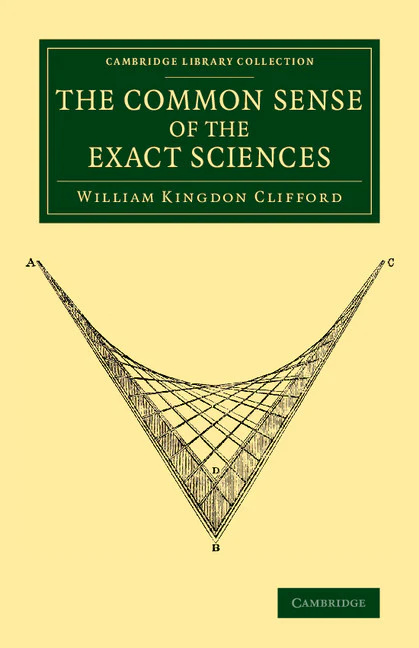
A student of Trinity College and a member of the Cambridge Apostles, William Kingdon Clifford (1845–79) graduated as second wrangler in the mathematical tripos, became a professor of applied mathematics at University College London in 1871, and was elected a fellow of the Royal Society in 1874. The present work was begun by Clifford during a remarkably productive period of ill health, yet it remained unfinished at his death. The statistician and philosopher of science Karl Pearson (1857–1936) was invited to edit and complete the work, finally publishing it in 1885. It tackles five of the most fundamental areas of mathematics - number, space, quantity, position and motion - explaining each one in the most basic terms, as well as deriving several original results. Also demonstrating the rationale behind these five concepts, the book particularly pleased a later Cambridge mathematician, Bertrand Russell, who read it as a teenager.
Product Information
Product Information
Shipping & Returns
Shipping & Returns
The Common Sense of the Exact Sciences
The Common Sense of the Exact Sciences
A student of Trinity College and a member of the Cambridge Apostles, William Kingdon Clifford (1845–79) graduated as second wrangler in the mathematical tripos, became a professor of applied mathematics at University College London in 1871, and was elected a fellow of the Royal Society in 1874. The present work was begun by Clifford during a remarkably productive period of ill health, yet it remained unfinished at his death. The statistician and philosopher of science Karl Pearson (1857–1936) was invited to edit and complete the work, finally publishing it in 1885. It tackles five of the most fundamental areas of mathematics - number, space, quantity, position and motion - explaining each one in the most basic terms, as well as deriving several original results. Also demonstrating the rationale behind these five concepts, the book particularly pleased a later Cambridge mathematician, Bertrand Russell, who read it as a teenager.
Product Information
Product Information
Shipping & Returns
Shipping & Returns
Description
A student of Trinity College and a member of the Cambridge Apostles, William Kingdon Clifford (1845–79) graduated as second wrangler in the mathematical tripos, became a professor of applied mathematics at University College London in 1871, and was elected a fellow of the Royal Society in 1874. The present work was begun by Clifford during a remarkably productive period of ill health, yet it remained unfinished at his death. The statistician and philosopher of science Karl Pearson (1857–1936) was invited to edit and complete the work, finally publishing it in 1885. It tackles five of the most fundamental areas of mathematics - number, space, quantity, position and motion - explaining each one in the most basic terms, as well as deriving several original results. Also demonstrating the rationale behind these five concepts, the book particularly pleased a later Cambridge mathematician, Bertrand Russell, who read it as a teenager.