Reliable Knowledge
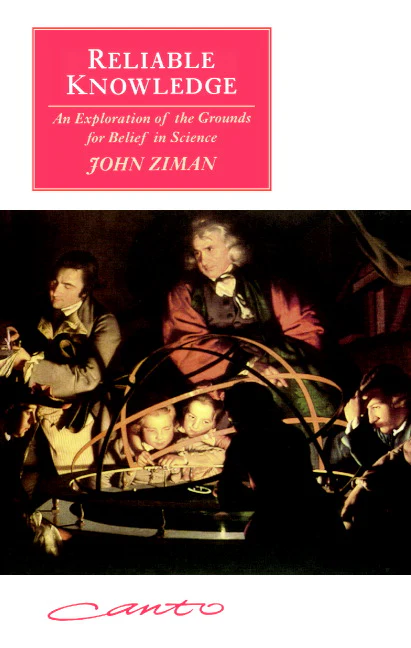
Why believe in the findings of science? John Ziman argues that scientific knowledge is not uniformly reliable, but rather like a map representing a country we cannot visit. He shows how science has many elements, including alongside its experiments and formulae the language and logic, patterns and preconceptions, facts and fantasies used to illustrate and express its findings. These elements are variously combined by scientists in their explanations of the material world as it lies outside our everyday experience. John Ziman's book offers at once a valuably clear account and a radically challenging investigation of the credibility of scientific knowledge, searching widely across a range of disciplines for evidence about the perceptions, paradigms and analogies on which all our understanding depends.
Product Information
Product Information
Shipping & Returns
Shipping & Returns
Reliable Knowledge
Reliable Knowledge
Why believe in the findings of science? John Ziman argues that scientific knowledge is not uniformly reliable, but rather like a map representing a country we cannot visit. He shows how science has many elements, including alongside its experiments and formulae the language and logic, patterns and preconceptions, facts and fantasies used to illustrate and express its findings. These elements are variously combined by scientists in their explanations of the material world as it lies outside our everyday experience. John Ziman's book offers at once a valuably clear account and a radically challenging investigation of the credibility of scientific knowledge, searching widely across a range of disciplines for evidence about the perceptions, paradigms and analogies on which all our understanding depends.
Original: $42.93
-65%$42.93
$15.03Product Information
Product Information
Shipping & Returns
Shipping & Returns
Description
Why believe in the findings of science? John Ziman argues that scientific knowledge is not uniformly reliable, but rather like a map representing a country we cannot visit. He shows how science has many elements, including alongside its experiments and formulae the language and logic, patterns and preconceptions, facts and fantasies used to illustrate and express its findings. These elements are variously combined by scientists in their explanations of the material world as it lies outside our everyday experience. John Ziman's book offers at once a valuably clear account and a radically challenging investigation of the credibility of scientific knowledge, searching widely across a range of disciplines for evidence about the perceptions, paradigms and analogies on which all our understanding depends.