Euripides: Phaethon
The surviving text of the fragmentary Phaethon of Euripides depends chiefly on two sources: two pages from a Euripidean manuscript, written about A.D. 500, and a papyrus of the third century B.C., which contains a substantial part of the parodos. These sources are supplemented by a number of citations in classical authors and by a recently published fragmentary hypothesis. Professor Diggle has examined all the manuscript evidence and offers many decipherments. He gives a text of the play and of the hypothesis, an exegetical commentary, prolegomena and appendices, in which he discusses the treatment of the Phaethon myth in classical literature and attempts a reconstruction of the plot of the play.
Product Information
Product Information
Shipping & Returns
Shipping & Returns
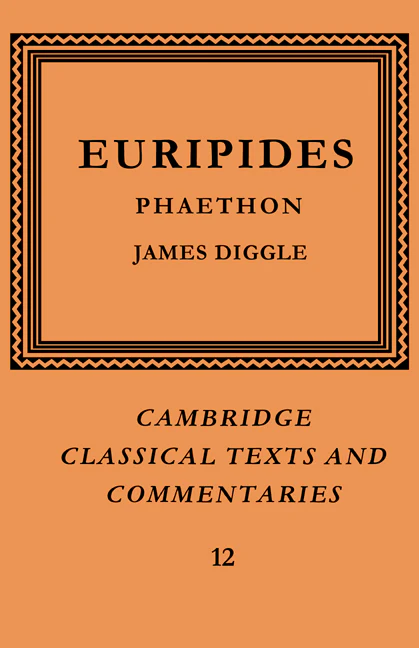
Euripides: Phaethon
Euripides: Phaethon
The surviving text of the fragmentary Phaethon of Euripides depends chiefly on two sources: two pages from a Euripidean manuscript, written about A.D. 500, and a papyrus of the third century B.C., which contains a substantial part of the parodos. These sources are supplemented by a number of citations in classical authors and by a recently published fragmentary hypothesis. Professor Diggle has examined all the manuscript evidence and offers many decipherments. He gives a text of the play and of the hypothesis, an exegetical commentary, prolegomena and appendices, in which he discusses the treatment of the Phaethon myth in classical literature and attempts a reconstruction of the plot of the play.
Original: $56.35
-65%$56.35
$19.72Product Information
Product Information
Shipping & Returns
Shipping & Returns
Description
The surviving text of the fragmentary Phaethon of Euripides depends chiefly on two sources: two pages from a Euripidean manuscript, written about A.D. 500, and a papyrus of the third century B.C., which contains a substantial part of the parodos. These sources are supplemented by a number of citations in classical authors and by a recently published fragmentary hypothesis. Professor Diggle has examined all the manuscript evidence and offers many decipherments. He gives a text of the play and of the hypothesis, an exegetical commentary, prolegomena and appendices, in which he discusses the treatment of the Phaethon myth in classical literature and attempts a reconstruction of the plot of the play.